Genre
Audience
Author’s Worldview
Lutheran Christian
Year Published
1837
Themes
Reviewed by
G.M. Baker
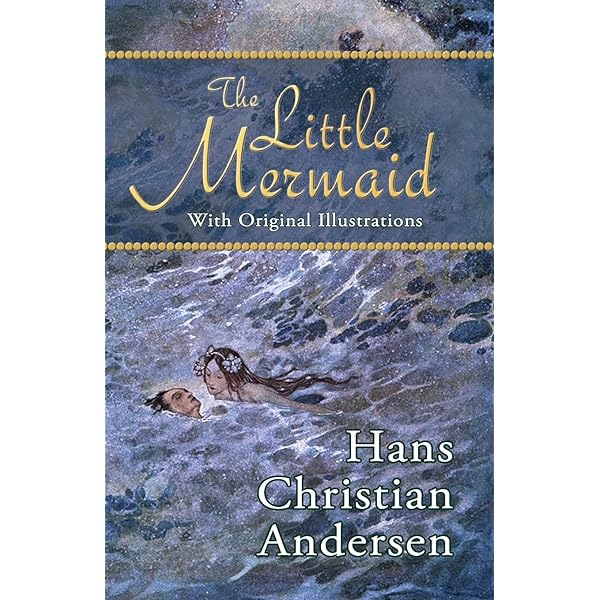
I have not forgiven Disney for what they did to The Little Mermaid. No, I am not talking about the recent live-action remake of the original animated movie, I am talking about what the original animated movie did to the original Hans Christian Andersen fairytale: the Disney version of the story is a travesty of the original.
It is easy to understand why Catholic parents might welcome the simple romance of the animated Little Mermaid as a clean and safe alternative to more modern entertainments. But the truth is that the Disney version of the story strips the tale both of its true fairytale qualities and of its deeply Christian sensibilities. For example, can you imagine this line of dialogue, from the original story, occurring in any Disney production:
“Why have we not souls?” asked the little mermaid. “I would willingly give up my three hundred years to be a human being for only one day, thus to become entitled to that heavenly world above.”
As in the movie, the little mermaid of the story rescues the prince from shipwreck, falls in love with him, and trades her voice for legs that she may court him. But in the original story, something else stands equal in her aspirations to winning the love of the prince. As her grandmother explains:
“It is true that if you could so win the affections of a human being as to become dearer to him than either father or mother, if he loved you with all his heart, and promised whilst the priest joined his hand with yours to be always faithful to you, then his soul would flow into yours and you would then become partaker of human bliss.”
By winning the love of the prince, in other words, the little mermaid will also win an immortal soul and trade the three hundred years of a mermaid’s existence for the eternity promised to human beings. But note here that it is not “true love’s kiss” that, in the movie, grants the little mermaid her desire. It is sacramental marriage.
Disney borrowed true love’s kiss from Sleeping Beauty and has spread it across many of its fairytale properties, including not only The Little Mermaid, but Snow White as well. It uses this device to turn ancient fairy tales into simple action romances. This reflects a broader cultural trend that has exalted romance over marriage to the point where many have come to feel that marriage is unnecessary if two people love one another, and also that the end of romance should spell the end of a relationship. Disney did not create this narrative, but follows it in all its fairytale retellings. One tragic consequence of this is that generations have grown up thinking the Disney versions are the true fairytales. Nothing could be further from the truth.
In Andersen’s Little Mermaid, there is no great battle as there is in the movie version. The little mermaid does not win her prince, and every step she takes on the legs she wins by giving up her voice feels like stepping on sharp swords. The prince marries another woman, a princess of another kingdom. In fairytale fashion, this princess is a peerless beauty and, remembering the beauty of the one who rescued him from shipwreck, he believes her to be his savior. Voiceless, the little mermaid cannot correct his mistake.
According to the spell which gave her legs, on the morning after the day he marries, she will die and, like a mermaid, turn into the foam of the sea. The little mermaid is given a last chance to save herself – I will not spoil the story further – but at a terrible price. Does she achieve her true goal – an immortal soul? Well, for that, you must read the story. And read it to your children too. Modern fairytales have become simplistic, relying on formulaic romance to provide a hackneyed happy ending. The real fairytale tradition, to which Hans Christian Andersen contributed so much, is much more subtle and much more honest, and much more spiritual as well. Andersen’s Little Mermaid is so much more than the Disney version, and you owe it to yourselves and to your children to discover the deep, sad, sacrificial beauty of the original.