Genre
Audience
Author’s Worldview
Undisclosed
Year Published
Themes
Byzantine empire, war, politics, rebellion, courtship, marriage, children, domestic life
Reviewed by
G.M. Baker
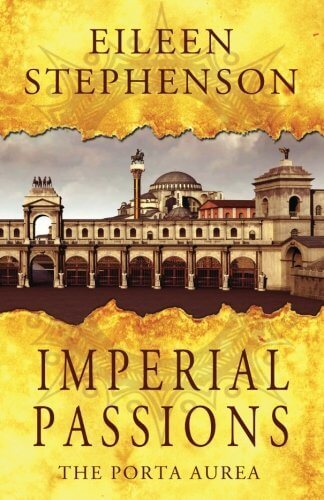
Eileen Stephenson’s Imperial Passions: The Porta Aurea is very far from being the bodice-ripper the title might suggest. Instead, it belongs to a genre I think of as “diorama fiction,” giving us a view of the history of the Byzantine empire between 1039 and 1057 that is both broad and intimate, through a combination of matters political, military, and domestic as they touch the life of Anna, a young noblewoman who manages, somewhat improbably, to be present at most of the significant events in the history of the city and its empire in that period. It is a turbulent time for the Empire, beset by external foes, religious division, internal strife, and Emperors of varying levels of skill and discretion. No one event dominates. Rather, it is the complexity of many trials and tribulations that marks the progress of the narrative. Anna’s own family members are sometimes on the outside and sometimes on the inside of the internal struggles, and sometimes touched by the external threats, but through it all, Anna grows from girl to woman, marries, and raises a family as the tides of fortune ebb and flow around her.
Anna’s own life unfolds with all the loves, losses, disappointments, and delights one would expect of a woman in her position, but there is no overarching dramatic arc to her story. She is, rather, a steady presence in a turbulent world who carries on calmly and efficiently, come what may. It is the story of the city and its wars and intrigues that dominates the book, and forms most of its drama, with Anna’s domestic life — her courtship, marriage, children, and family affairs — forming interludes between the historical and cultural descriptions, though the two streams do converge at the end of the book. Anna is our guide to the political, cultural, and domestic life of the empire in the mid-eleventh century, her calm voice assuring that things will work out well for her family in the long run.
Anna is an observant Christian, but her religious practices and observances are routine and habitual, as would have been the case for many people of that time. The Great Schism begins during the timeline of the book, and Anna takes the local side in the dispute between Rome and Constantinople, but this forms no significant part of her story. There is no conspicuous struggle with, or inspiration by, faith in Anna’s life. The incident that she relates is, rather, one more exhibit on her guided tour of the city and its history. Nothing about the religious aspects of the book is likely to upset either Catholic, Orthodox, or secular readers.
Sensitive readers should be aware that there are a few scenes with mild vulgarity and several mild scenes of intimacy. There is also one scene in which Anna is kidnapped by marauding soldiers and threatened with rape. A boy who is part of her household tries to rescue her and is killed before her eyes, before John, her future husband, rides in to save the day. This scene is remarkable not for any graphic violence but chiefly for how little the event seems to upset Anna or her family, who are depicted as laughing over a game of chess later the same evening. Anna suffers a second attempted rape towards the end of the book, but as before, her feathers are never more than momentarily ruffled. There are several depictions of acts of torture and violence, but they are not particularly graphic or disturbing. They are, one might say, rendered in a way that is exciting but safe for our tour group.
The novel gives every appearance of being meticulously researched. I am not an expert on this period, so I cannot really judge how accurate the portrayal of times, places, and attitudes is, but every time I felt moved to look something up to verify an event or an item, my research fully supported the novel. I particularly appreciated the fine details of the Byzantine version of the game of chess, with pieces such as elephants. The presentation of the historical details is confident and confidence-inspiring. While it is very clearly a research-forward historical novel, the integration of research and story is smooth and effortless, and the historical elements are presented clearly and articulately, giving us a clear and convincing portrait of the political and domestic life of the Byzantine Empire in the mid 11th-century.
The cast is vast, and several characters have the same first names. It is sometimes hard to tell the players without a scorecard, but Stephenson helpfully provides a character list. Those who like to be able to keep track of these things might find it easier to read the novel in paperback rather than an ebook so that they can keep a thumb in the character list for quick reference. Stephenson also provides a glossary of unfamiliar terms and a brief historical note and bibliography.
Those seeking high drama will not find it here. What they will find is an amiable and articulate guide through the life and times, political and domestic, of eleventh-century Constantinople. If this is your cup of tea, Imperial Passions: The Porta Aurea will provide a well-brewed pot.