Genre
Audience
Author’s Worldview
Year Published
Themes
Reviewed by
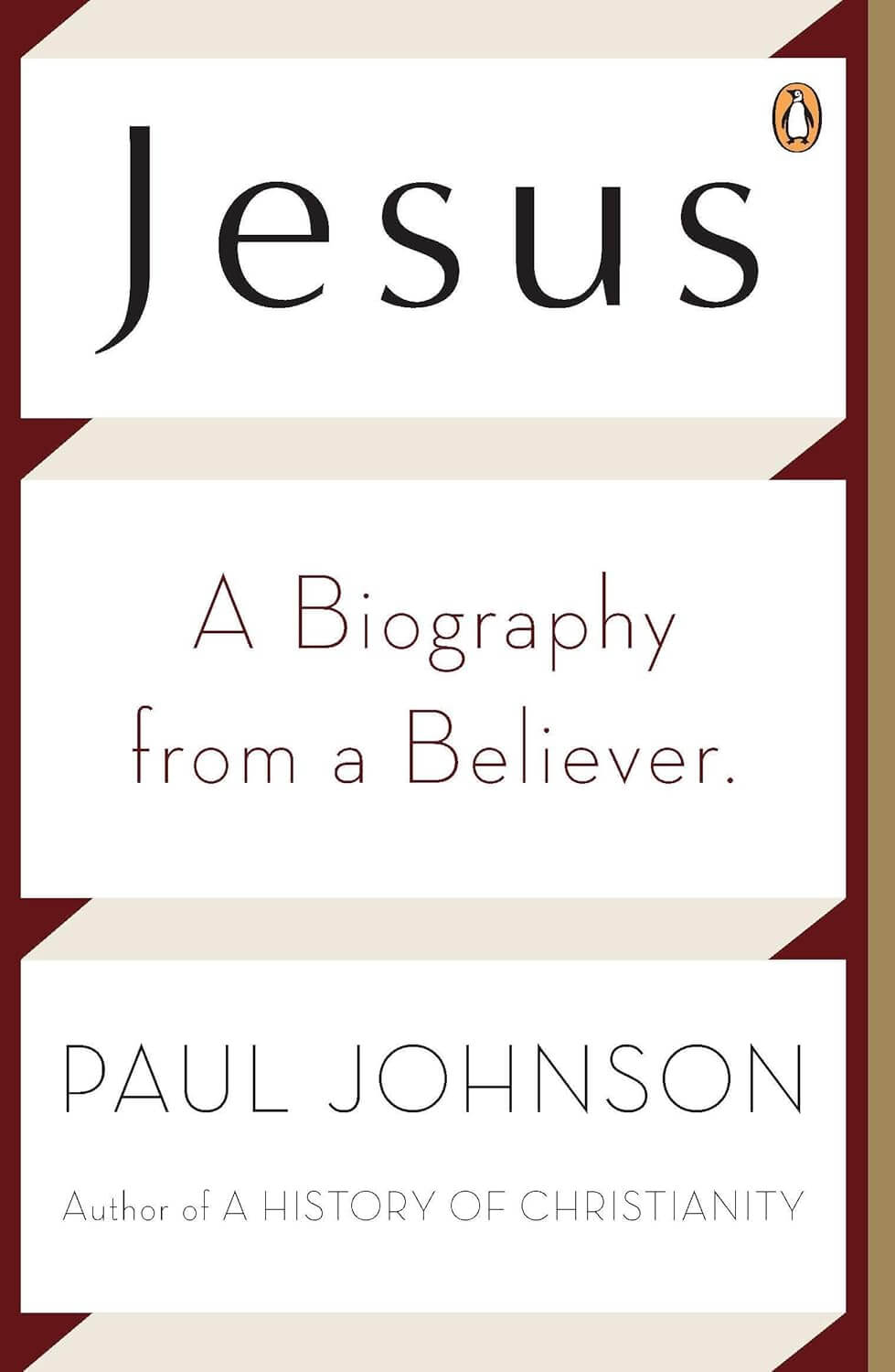
As the English Catholic journalist and historian Paul Johnson points out in the introduction to his biography of Jesus, there are over one hundred thousand printed biographies of Jesus in English alone. Why therefore am I recommending this one? It’s not, naturally, that I have read the other one hundred thousand and found this the best of them all. But it has a number of features that appeal to me.
First, I have long been a fan of Johnson’s work, such as his books on Creators and Intellectuals, both of which I highly recommend. Johnson possesses that rare combination of clarity of thought and clarity of expression, and a calmness of expression that does not suppose that histrionics or hyperbole can capture the astonishment that the person and claims of Jesus evoke, and so allows the wonder of the claims themselves to come through clearly through the simple statement of the life and the claims themselves.
Secondly, the book is framed as “a biography by a believer,” and it stays true to this framing. Johnson treats his subject as a journalist and historian would, but without the skeptical pose that most journalists and historians would feel obliged to strike. Johnson manages to maintain his professional integrity as a journalist and historian without distancing himself from his faith, a very difficult thing to pull off these days. At the same time, Johnson does not make any pretense at being a theologian. The book bears no imprimatur or nihil obstat, nor would it have been appropriate to seek one for a work of this type. This distinction, I feel, is itself sufficient reason to justify the existence of this book among the other hundred thousand.
Thirdly, Johnson does an excellent job of placing Jesus and his teachings in the context of his place and time. It is in many ways difficult to appreciate the revolutionary nature of Jesus’s teaching in our times, since while much of it has been rejected, significant parts of it, such as universal human dignity, are still believed, at least in principle, and set the current world, even in its most materialist aspects, firmly apart from the highly tribalized world of Jesus’ time.
When Jesus was asked “[W]ho is my neighbour?” (Lk 10:16), his answer was: everyone. He turned compassion, which all of us feel from time to time for a particular person, into a huge, overarching gospel of love. He taught the love of mankind as a whole.
If we have forgotten how utterly revolutionary this idea was in its time, Johnson provides a salutary reminder.
I also like how Johnson frames what he sees as the paradox of the political impact of Christianity, given its essentially spiritual nature:
The key to the life of Jesus is a huge paradox: the most striking and important paradox in world history. Jesus aimed to show men and women how to prepare themselves for the next world, to make themselves worthy of it. But he did so with such grace and skill, such psychological and emotional brilliance, that he also gave them a pattern to follow which made them better, and therefore happier, human beings in the present world. At the heart of Christianity is the imitation of Christ. The Gospels show how the perfect person behaves and thinks and speaks. By imitating Christ to the best of their limited abilities, those who have followed him over two thousand years have made the world a better place, and they have enabled many of those who dwell in it to lead more fulfilled and happier lives.
This paradox between life in this world and the preparation for life in the next has concerned Christians for centuries. It is a central problem for Christian rulers in particular, who must deal with the governing of sinful people without turning into theocrats. But it is a problem for every Christian living an ordinary life in the world along with those of other faiths and none.
An interesting feature of the books is Johnson’s parsing of Christ’s teaching into what he calls a new ten commandments. If Christ’s universal commandment of love stands on the preparation-for-the-next-life side of the paradox, Johnson’s ten commandments might be seen as standing on the live-in-this-world side of the paradox. Briefly, are:
- Each of us must develop a true personality
- Accept and abide by universality
- Respect the fact that we are all equal in God’s eyes
- The need for love in human relationships
- We are to show mercy just as God shows it to us
- Live a balanced life
- Cultivate an open mind
- Pursue truth
- Exercise power with restraint and moderation
- Show courage
The chief value I find in this is not that I agree with every word of it, but that this framing provokes a reexamination of the problem of living a Christian life in the world. Similarities may be noted to Jordan Peterson’s twelve rules for life, but I prefer Johnson’s more succinct and more fully Christian version. This book is not a work of dogmatic definition, and one may disagree with Johnson on certain points of emphasis or interpretation, but this brief, simple, elegant volume is an excellent prompt for reexamining and reconsidering one’s understanding of Jesus’s thought and his place and role in history.