Genre
Audience
Author’s Worldview
Catholic
Year Published
2023
Themes
family, grief, providence, the power of story, hope, healing, forgiveness
Reviewed by
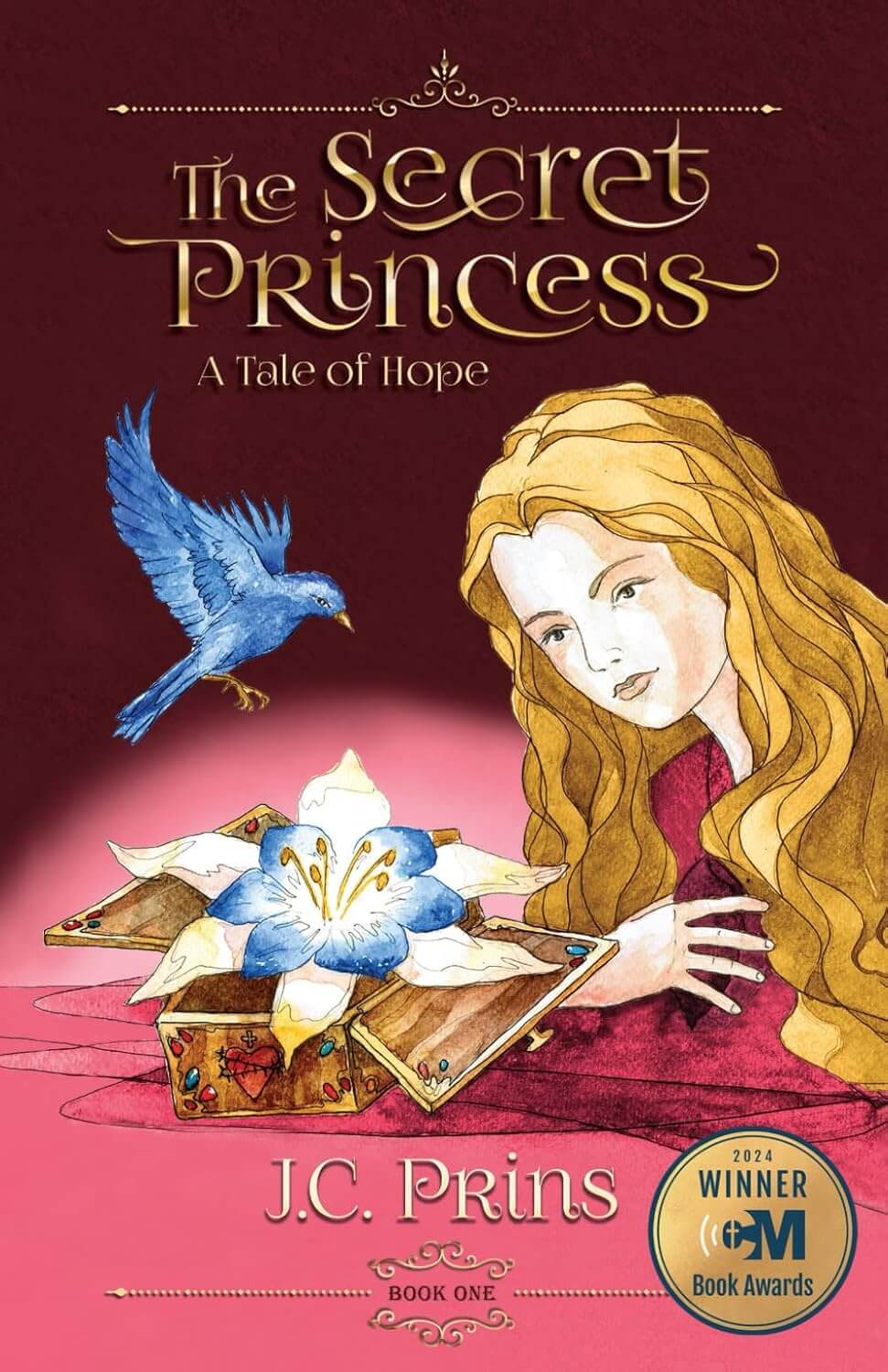
In a magical land known to the reader only as the “Kingdom,” every woman possesses a magical locket that “reflects her heart and spirit.” Inside each locket, a magical bloom may grow, and a lovely little bird might live—if her heart is well-tended. Ten-year-old Miriam’s little bloom is in danger of withering away after the death of her father. If it dies, she will not have her own little bird to live inside it, as her mother once did before her father’s death. Instead, her locket may become hard and cold like her churlish grandmother’s. Miriam’s mother is too lost in her own grief to be able to help her daughter, so Miriam’s one solace is the kindness of their new neighbor, Leena. Leena tells the most wonderful stories, and when Miriam listens, her little bloom begins to heal. But all it takes is a moment of her grandmother’s meanness to undo what progress Leena’s stories make. It seems like there is no hope. Even the king has not answered their request for help. Or has he?
The Secret Princess is a lovely little story about finding hope, healing, and new beginnings in the midst of grief and hardship, and how God can often surprise us with the unexpected ways He answers our prayers. It has strong Catholic themes and references, including the attendance of Mass, reverencing a Sacred Heart of Jesus statue, and devotions to the Eucharist and the Sacred Heart of Jesus. Children ages 8-12 years old will likely enjoy it most—particularly girls—though it offers truths for all ages, much like a fairytale. It includes charming, full-color watercolor illustrations, and an appendix with prayers to the Sacred Heart of Jesus.
I actually brought in an expert to help me with this review—my ten-year-old niece. She read it in two days (I read it in a couple of hours). When asked what she thought of it, she said it was exciting, in that she didn’t want to put it down and stop reading it. High praise, I’d say. She also said she would definitely recommend it to her friends, and immediately asked me if I had book two. The Secret Princess is billed as “book one,” but a second book has yet to be released, much to her disappointment. She is awaiting it eagerly.
Miriam, our protagonist, is an unusually self-aware ten-year-old. She struggles against anger and bitterness through much of the story as she wrestles with her own grief and has to witness the grief of her mother, siblings, and grandmother. Their stories are an honest look at grief, and how much it can take out of us. Miriam’s mother is not uncaring, but she is tired and hurting, and has little support since the loss of her husband—something with which single mothers (and fathers) will likely relate. Her struggle highlights how important it is to have friends and family to support us in the midst of hardship, especially when grief has made prayer and continued faith difficult.
Leena’s friendship and support help Miriam’s mother, as well as Miriam, in many ways. For Miriam, Leena’s stories are particularly special. Jesus appears in these adventures, and they seem to me like the fruit of Leena’s imaginative prayer (one of my personal favorite ways to pray). Since they are rather abstract and symbolic, I asked my niece if she knew what these stories meant. Some of them were explained in the narrative, and she remembered their meanings, though there was one that was not clearly explained, and she did not understand it. However, she surprised me with a lovely interpretation of one of the stories that hadn’t occurred to me—which is the beauty of symbolism. They are a great conversation point for parents and their children.
One of the key symbols throughout the story is, of course, the magical locket. My niece grasped the role of virtues, which appear as jeweled adornments upon the lockets of those who possess them. However, it was unclear even to me whether it was merely emotion that caused the flower to bloom or something more important. I would like to think that it is grace or perhaps love that makes the lockets come alive, but that wasn’t clear to my niece. When we talked about it afterward, she thought that made sense, but she didn’t guess that grace, rather than just emotions, were the cause of the locket’s positive growth. I encourage parents to have that conversation with their children during or after reading, since, though our emotions can often affect how open we are to receiving grace, they are not clear markers of when and where grace is working. Grace can, and often does, work in our lives without the accompanying positive emotions, and can certainly reach us even in the midst of negative emotions. Love, as well, is often a choice we make despite our emotions, though I do think the final scene in the book illustrates this.
One of the reasons I brought my niece in on this read was to see whether or not she was tripped up by the advanced vocabulary sprinkled throughout the narrative. Words like “perfunctorily,” “mollified,” “satiated,” and “glibly” were far above the middle grade reading level of the target audience, and the definitions were not easily deduced from the context. However, my niece did not seem much bothered by this, though she did admit to stopping to try to figure out the words she didn’t know and skipping the ones she couldn’t figure out. From an editor’s standpoint, these words sound strange in the mouth and mind of the ten-year-old first-person narrator, even in a fantastical setting, and would have been more at home in the voice of a third-person narrator. In a similar way, Miriam is extremely self-aware for that age, at one point referencing her own “innate cynicism,” for example. But despite these things, my niece still understood the gist of the story, and clearly enjoyed it.
The one thing my niece found strange and confusing was the odd betrothal of an adopted prince to the daughter of his adopted father. This is a minor point mentioned toward the end that does not really affect the rest of the story, but it did give me pause and baffle my niece. I think the author was attempting an allegory, with the adopted son becoming the heir to the kingdom. However, when practically applied to the story, it doesn’t make sense. A young man was adopted by the king in order to become the heir to the kingdom (the prince), but is also betrothed to the daughter of that same king (the princess). This doesn’t actually work with Catholic thought, in which one’s adopted siblings are truly one’s siblings, no different than if they were siblings by blood. It’s an odd choice by the author. If the young man married into the family, he would not need to be adopted into it, and if he was adopted into it, he’s technically the princess’s brother and could not marry her. I guess we’re chalking this up to it being a fantasy world? But it does stand out in a book that in all other ways clings tightly to its Catholic identity.
Overall, the story was charming and filled with the kind of fairytale mystery that intrigues readers both young and old. It will most appeal to a Catholic audience or people open to the Catholic faith, with its inclusion of clear Catholic sacraments, traditions, and devotions. I’d recommend it for middle grade readers from 8-12, though a more advanced reader of a younger age can also enjoy it, and there are plenty of words that will challenge even a teen reader.
I wish I could tell you more of what my niece loved about the story without giving spoilers, but there are some twists toward the end that she really enjoyed. I guess you’ll just have to go read it yourself!