Genre
Audience
Author’s Worldview
Year Published
Themes
Reviewed by
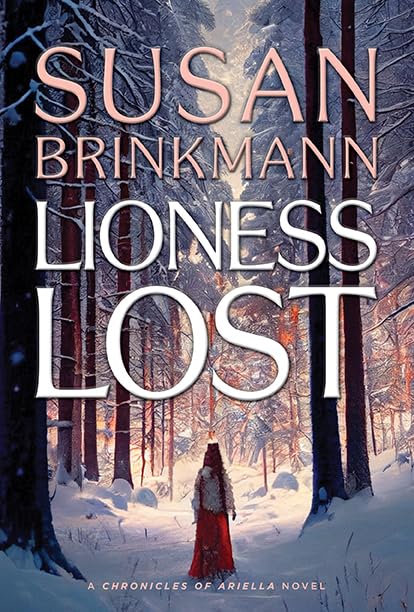
Investigative reporter Ariella “Ari” Dalton is assigned to cover a vicious murder at her grandmother’s church, carried out by a Satanist gang. The only bright point in the dark world her investigations lead her into is the very handsome—and very Catholic—FBI agent in charge of the case, Jesse Sandoval, who clearly returns her interest. As she searches deeper, she begins to question some of her New Age beliefs. She also finds out about her ancestor, Ella Ward, who lived during the Gilded Age of the late nineteenth century and was involved in shaping the Church’s response to the Social Justice issues of the day.
This is a well-written first installment in an upcoming crime/romance/family saga, and an easy read from start to finish. Although Catholic author and journalist Susan Brinkmann (a New Age and occult expert) makes it clear in the introduction that this is a semi-educational fiction series intended to educate about the risks of the New Age movement, she pulls off a good quality, readable book. I’m actually a big fan of ‘semi-educational fiction’ when it’s done well, since it can be a very engaging way to learn, but it is hard to pull off so I was pleased Brinkmann succeeded so well.
Ari is a likeable protagonist, and it is satisfying to see her beginning to heal from her childhood neglect. FBI Agent Jesse is an appropriately swoon-worthy romantic interest, and their nascent romance was one of the most engaging things about the story, along with the sweet historical narrative.
Catholics appear to be Brinkmann’s intended audience. Hence, the introduction seems to be crafted to reassure Catholic readers that the book is ‘safe’ and that the series will eventually be wrapped up in an acceptable way. Yet readers looking for specifically Catholic fiction may be far less engaged—even turned off—by a main character who is wholly secular in outlook and practicing New Age spirituality. I can’t help feeling that an opportunity may have been missed to market this series to mainstream readers.
Although I found the jump into the historical narration, occurring just when I’d become thoroughly invested in the contemporary romantic plotline, somewhat jarring, I quickly became invested in that plotline as well, and yes, I learned something about how the Church’s social justice teaching evolved in a time of rapid technological and societal change. I assume from Brinkmann’s introduction that each book in the series will explore a different ancestor’s story, and a different period of Church history, and I’m looking forward to learning more.
On that subject, it should be noted that Lioness Lost is very much the first installment in an episodic series. The historical narrative was completed in this volume, but the main plot was not resolved. At the end, both the crime investigation and the romance plots are still in their infancy. The fact that I immediately checked if book 2 had been released yet (it hasn’t) because I wanted to read on means that Brinkmann is doing something right. But readers should approach this as a first installment and not as a complete novel in order to avoid disappointment.
This book would be suitable for secular readers who are friendly towards Catholic points of view and prepared to have their view of New Age practices challenged, as well as for Protestant readers who are open to a positive presentation of Catholicism, and Catholic readers who are prepared to read some New Age content with the promise of it all being (eventually) debunked. This is a very promising first installment in a well-written semi-educational fiction series offering something for everyone: crime, romance, and history.