Genre
Audience
Author’s Worldview
Catholic
Year Published
2025
Themes
Catholic, Parents, Caretakers, Pro-life, Special Needs Child, Epilepsy, Cerebral Palsy, Blind, Non verbal, Congenital brain malformation, Septo-optic dysplasia, Schizencephaly, dystonia
Reviewed by
Theresa Frodin
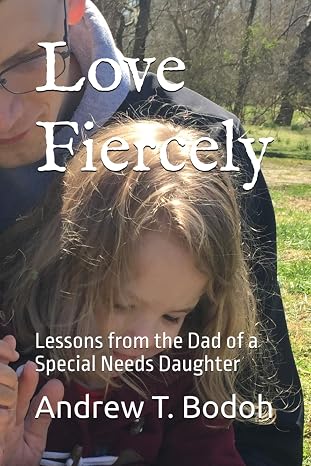
When I saw this book, Love Fiercely, Lessons from the Dad of a Special Needs Daughter, by Andrew Bodoh, I confided to my husband that reading it might break me. Could I make space for a fellow parent and his special needs child, Elizabeth, knowing that she will never get better? Would I mourn all the things that Elizabeth will never be able to experience? I don’t have a special needs child. Yet, as a parent, some days feel debilitating and isolating. Reading this book had the potential to break my heart or leave me with low emotions. Would this book generate feelings of failure in not doing more for my children? Would this book address the question of why a loving God would allow an innocent child to suffer? I also hoped that the twelve “lessons” would not be preachy. In trepidation, I opened to the preface. My eye landed on the words “great joy.” Immediately I sensed that encountering this particular father-and-daughter relationship would be of benefit to me.
Andrew Bodoh, father of four, graduated from Christendom and then Ave Maria School of Law; today, he works as a litigation attorney in Virginia specializing in civil rights and Constitutional law. He met his wife, Joyce, at Saint Mary of the Immaculate Conception—the parish where they still worship. Elizabeth, their eight-year-old daughter and their oldest child, is “nearly blind, nonverbal, suffers from epilepsy and cerebral palsy, and loves music. She enjoys cuddles and eating. A shunt manages the fluid on her brain, and a wheelchair helps her family move her.” Andrew says that most people either view her as a tragedy or as an angel, yet she is neither. Those concepts are not the lived reality.
In utero, at twenty-two weeks, Elizabeth was discovered to have brain malformation. A specialist recommended her termination. Andrew and Joyce, initially excited about the pregnancy, now built an emotional wall between themselves and their child as they prepared for the worst. But then a perinatologist shared with them his experience of the short life of his deceased special needs daughter—a life really lived. This gave them hope. This doctor connected them to a nurse who was willing to be supportive through Elizabeth’s journey. This helped them re-embrace the joy of pregnancy, come what may.
In Love Fiercely, Andrew reflects on what did in fact come next: anxiety, hospital visits, and social, medical and institutional injustices. Andrew wrote much of this book while in the hospital at his daughter’s bedside and while waiting for her to come out of surgeries. In his lessons, he speaks of giving up control; the isolation in having a chronically sick child; and the sacrifice required by fierce love. He uses scripture, prayer, encyclicals, photographs and anecdotes to show that this sacrifice is joy. People tend to see a disability and dictate the mood that should go with it. Andrew tries to proactively counter the assumption of a mournful mood. He does not want pity for Elizabeth, so he sings to her in public. When people see her full of joy, it changes their perception. Instead of pity, they have compassion for her limitations. Another story that stuck with me was not about Elizabeth, but about Andrew feeling depleted. Once when on a walk, while waiting for his daughter to go into surgery, he contemplated the freedom he would have without Elizabeth. Andrew remembered his relatively care-free college days. The cup of joy that he had to fill in college was relatively small and could be filled up easily. But then he reflected that after Elizabeth’s birth, his capacity had grown. Any emptiness he sometimes felt was deeper and wider, but when filled, his joy was more profound. This reminded me of St. Therese’s description of the Beatific Vision: God fills us up according to our capacity. Saint Thomas Aquinas says that we are only able to expand/deepen that capacity by acts of love.
This book is an example of lived acts of mercy. While some might wonder “why me,” or “why a special needs child?” Andrew says that he doesn’t deserve to be the father of this beautiful girl. When he looks at Elizabeth, he thinks, “What a loving God to give me her!” She is part of his salvation. “For I was hungry and you gave me food, I was thirsty and you gave me drink, a stranger and you welcomed me, naked and you clothed me, ill and you cared for me, in prison and you visited me. . . Amen, I say to you, whatever you did for one of these least brothers of mine, you did for me.” (Matthew 25: 35-36, 40).
Andrew says to Elizabeth,“Beautiful girl, you can do amazing things.” This wonderful affirmation is seen through the attitudes of the whole family. His wife just gave birth to a boy, their fourth child; they did not let sacrifice stop them from expanding their family. Photos display sibling love: one of Elizabeth’s younger siblings hugging her; another, a sister feeding her. At an early age, the girls learned how to push Elizabeth’s wheelchair. Elizabeth teaches the family compassion; they give her joy. Andrew is proud of his daughters for participating in relational love. He encourages them to extend this love to their community, praying for everyone who walks with them: family, parish members, therapists, nurses, doctors, nannies and teachers.
Andrew’s lessons are not preachy; they are inspirational. They widened my compassion; not just for families and individuals that I know that have special needs, but even for myself. He showed me that I can be more forgiving of my own limitations and in some of my parenting shortcomings. And I am reminded that I need not judge one’s value against one’s life expectancy, disease or ability. I am proud of my own children for not shying away from having friendships with those who are different from them. I am happy that my children are thriving amid their own limitations. I am grateful for the sufferings and joys of my life in a deeper way for having read this book.
I recommend Love Fiercely, Lessons from the Dad of a Special Needs Daughter for all parents, caregivers, pro-lifers, and anyone looking to understand relationships or suffering better. Less than a decade ago, Elizabeth was in the NICU, and today she is delighting her father with her love of music and wheelchair dancing.