Genre
Graphic Novel, Historical Fiction
Audience
Ages 13 and Up (contains some gore & war related violence)
Author’s Worldview
Catholic
Year Published
2019
Themes
Joan of Arc, medieval history, heroism, saints, apparitions, French history

Reviewed by

Courtney Guest Kim
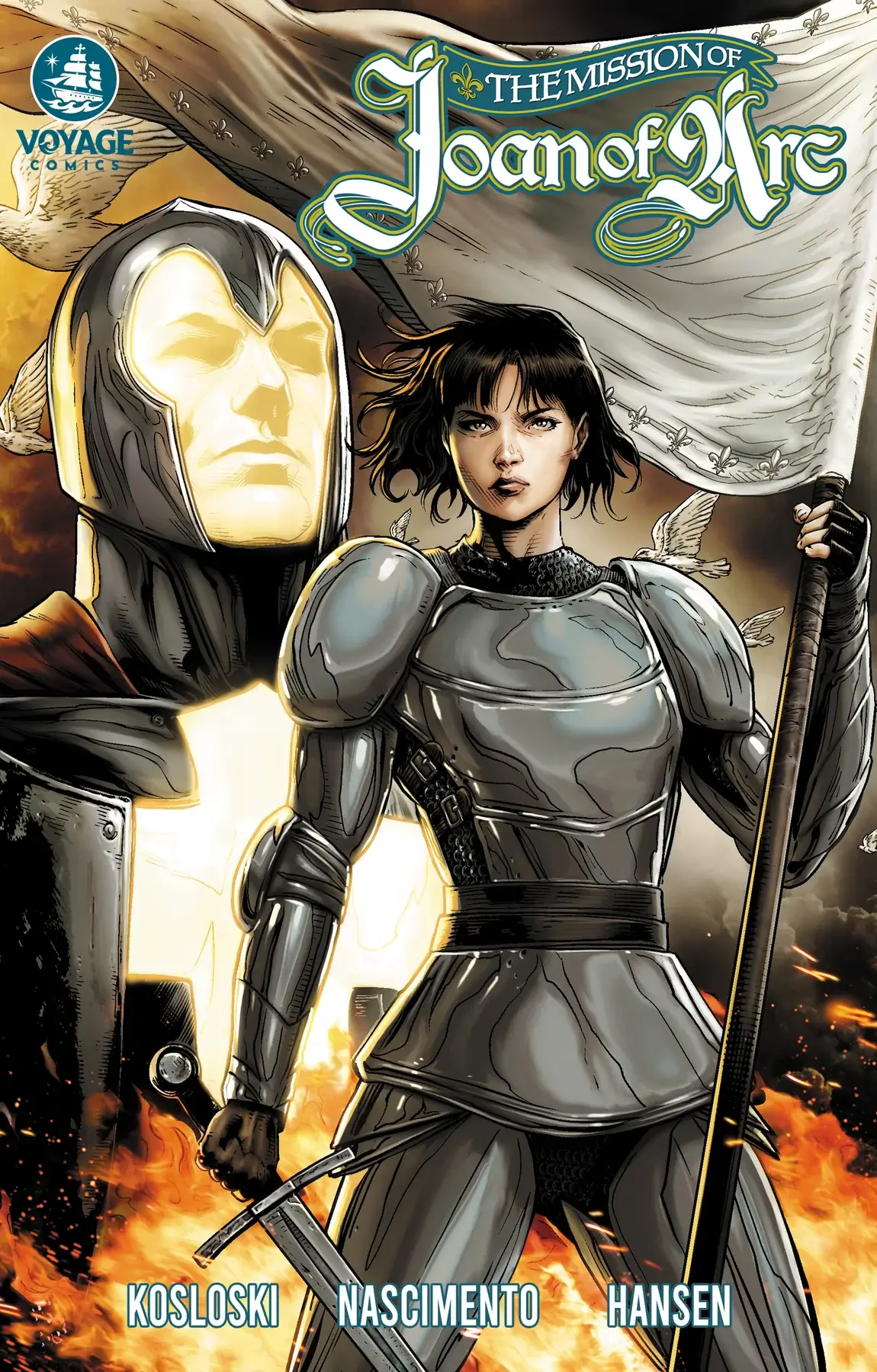
The Mission of Joan of Arc opens in the middle of the action at the crisis point of 15th century French history, with the siege of Orléans. Visually, the vantage point is that of the French soldiers defending the medieval city from the top of its ramparts. They can’t hold out much longer against the English troops. We learn from these French defenders of a prophecy about a Maid of Lorraine, who will save France. Then the illustrations cut to young Joan, receiving a vision of Michael the Archangel. At first, she refuses the strange commission to put the French crown prince on his rightful throne. She prays to St. Catherine for advice. And the rest is history….

Part one of this graphic novel goes on to tell how Joan overcomes the skepticism of the French leaders. She cuts her hair and dresses like a soldier—a decision that will have fateful results. A revelation shows her the location of an ancient sword buried at the church of St. Catherine. She claims this sword as her own, although she herself does not kill anyone in battle, despite being on the front lines, leading the French troops. At the height of success, she receives a supernatural warning of her own future suffering and personal defeat, which will however contribute to the success of her mission.

Part two takes us back to the city of Orléans after it has been captured by the English. Now the roles are reversed, and Joan is leading the French troops in the assault to take back the city. She is victorious, and as a result, the French prince is crowned Charles VII. He himself is no saint, and the political intrigues of the day result in the betrayal of Joan, who is captured by the Burgundians and sold to the English. Imprisoned in Rouen, she is charged by her captors as a heretic and interrogated for weeks. Condemned to death, she is burned at the stake on 29 May 1431. The final image is of Joan both burning and beholding St. Michael in heaven, calling to Jesus.

Voyage Comics’ interpretation of the Life of Joan of Arc is based on the play written by St. Thérèse of Lisieux, and an afterword gives some background about that source material, as well as filling in some historical details. (Declared innocent by the Church in 1456, St. Joan of Arc was canonized in 1920.) The dynamic, vivid illustrations capture the sheer energy of the life and times of the peasant girl who would become a saint. The medium of the graphic novel makes it possible to apprehend the brutality of her environment and the mysterious quality of her calling, without such shocking images as to make the narrative unsuitable for young readers. It is an excellent rendition in its faithfulness to source material. Both the knowledgeable adult reader already familiar with Joan’s story and the young comic book fan with no prior information can enjoy and learn from this fantastic resource: a saint’s life truly brought to life by the intertwined narrative and visual art of the graphic novel.


Saving Cinderella: What Feminists Get Wrong About Disney Princesses And How To Set It Right by Faith Moore

Love the Disney movies you grew up with but don’t know how to defend them in the face of the modern critics? This book is for you.

Max Medal Knight, Volume 2 By Voyage Comics

To save his mother, Max must don his knight’s armor for the first time.

Blink and We’ll Miss It by Ginny Kochis

Back amongst her estranged best friends and former love, Mae tries to hide her time-hopping secret.

The Saving Power of Suffering By Father Jacob Powell

A Catholic guide to taking up our cross and following Jesus.

Cinder Allia by Karen Ullo

A political fantasy epic bildungsroman where Allia’s feminine heart becomes as powerful a force has her sword.

Hologram by Walker Larson

Aaron is the only one who can see through the holograms.

Finnian and the Seven Mountains (Vol. 1) by Philip Koslowski, Michael Lavoy, and Jim Fern

Join Finnian as his quest for a legendary sword takes him to the monks of Skellig Michael, a real life inspiration for the Jedi temple.

By Violence Unavenged by Annette Young

A Catholic Historical Epic to Rival The Sound of Music.

Zeal & Zest: Where to Begin with Hillaire Belloc

Belloc was known as a Catholic polemicist with a vicious talent for skewering his opponents. Anyone struggling to persevere as a Christian in the fields of journalism or media should read him. His children’s books have an acerbic humor that will appeal to bored veterans of political correctness, especially teens.

Through the Ashes by Jacqueline Brown

Fans of The 100 and Runaway’s and The Gifted will find this YA story riveting.

Defend the Tabernacle by Deacon Patrick Augustin Jones

Catherine and Bernard get whisked away to do battle on the Soulscape, where the true nature of things is revealed.

When Headlines Hurt: Do We Have a Prayer? by Bill Schmitt

The Pope’s Words of Hope for Journalism

Feel-Good Books For Pandemic Summer

Book Therapy to chase the blues away

The Divided Kingdom by Allison Ramirez

What sinister secrets hide behind the walls of the Island of Mirror?

North Pacific: A Story of Life, Love, Suffering, and Grace by Michael Steffan

Joseph & Miku’s love was already illegal. Then WWII began. Now home, disabled, and questioning God’s love, he still searches for her.

Saving Mt. Rushmore by Andrea Jo Rodgers

John’s summer plans are ruined when he is recruited to a top-secret crime-fighting school, St. Michael’s Academy.

Trapped in Time by Jerry J. Weis

Can a team of misfit teens save the day in this wholesome time-traveling romp?

Minding Mom: A Caregiver’s Devotional Story By Lisa Livezey

A fifty-two-day devotional book for caregivers.

Outlaws of Ravenhurst, by Sr. M. Imelda Wallace, S.L.

The 10-year-old heir of a noble Scottish family must choose between his inheritance and his Catholic faith.

Pinocchio and Reflections on a Father’s Love by Franco Nembrini and Carlo Collodi

Delicious literary spumoni of 19th century Italian fairytale, Catholic theology, and reflections on the life of faith.