Genre
Audience
Author’s Worldview
Year Published
2022
Themes
Reviewed by
G.M. Baker
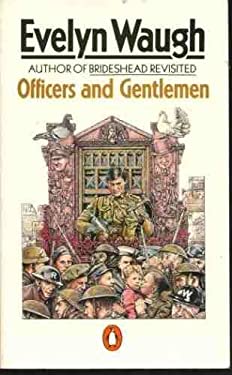
The first volume of Evelyn Waugh’s Sword of Honor trilogy, Men at Arms, ended with Guy Crouchback in disgrace through no fault of his own. The second volume, Officers and Gentlemen, finds him, through no virtue of his own, and on account of the same incident that caused his disgrace, assigned to one of the newly formed commando units training on the Scottish island of Mugg. There he encounters its eccentric laird, whose chief concern is to pilfer explosives for a private project; the laird’s even more eccentric niece, a Nazi sympathizer; and a number of eccentric soldiers and civilian advisers, including the cowardly Trimmer, who will stumble backward into glory.
While the first half of the book is concerned with the dark comedy on the Isle of Mugg, the second half finds Crouchback landed in Crete, just as British forces on that island are broken and in retreat.
Evelyn Waugh’s full powers of description are on ample display in this book, starting with the opening paragraph:
The sky over London was glorious, ochre and madder, as though a dozen tropic suns were simultaneously setting around the horizon; everywhere the searchlights clustered and hovered, then swept apart; here and there patchy clouds drifted and billowed; now and then a huge flash momentarily froze the serene fireside glow. Everywhere shells sparkled like Christmas baubles.
Portraying the blitz as a kind of fairyland scene sets the tone for Officers and Gentlemen, establishing a sense of otherworldliness that follows Guy Crouchback through all his adventures. But there is more than mere surrealism at work here. On the next page, we find:
A crescent scream immediately, it seemed, over their heads; a thud which raised the paving stones under their feet; a tremendous incandescence just north of Picadilly; a pentecostal wind; the remaining panes of glass above them scattered in lethal splinters about the street.
That pentecostal wind is a harbinger of the moral and spiritual crisis that arises for Guy out of the absurdity of his wartime experiences. Most war novels are played either for adventure or for the physical or psychological damage they do. But Waugh’s theme here has much more to do with the moral effects of war, specifically with how it wears away at the moral capacity of the men who endure it.
Much of this wear comes not from action but from the endless waiting, and from being repeatedly moved about from one place to another as part of one aborted operation after another.
There should be a drug for soldiers, Guy thought, to put them to sleep until they were needed. They should repose among the briar like the knights of the Sleeping Beauty; they should be laid away in their boxes in the nursery cupboard. This unvarying cycle of excitement and disappointment rubbed them bare of paint and exposed the lead beneath.
Here again, we get that fairytale imagery, reinforcing the otherworldliness of his wartime experience. All of this waiting and all the false alarms are deeply demoralizing for Guy:
In the war of attrition which raged ceaselessly against the human spirit, anticlimax was the heavy weapon.
One comes to realize that the word demoralizing is not only or even principally about cheerfulness or optimism but about one’s confidence in moral norms. Everywhere, Guy finds moral failure. One of his friends defies an order and deserts his men in the face of the enemy. Guy goes to a Catholic priest in Cairo to perform his Easter duties and realizes that the priest is a spy pumping him for information on troop movements.
His own chief concern is not his life or safety but the moral imperative to find a place in the world and to do what is expected of him.
It occurred to him on that morning of uncertainty that he was behaving pretty much as a Halberdier should. He wished Colonel Tickeridge could be there to see him.
At one point in the retreat, Guy’s truck meets a German motorcyclist coming the other way. The British turn around and flee:
Unmolested they backed and turned and drove away. After half a mile Guy said, “I ought to have shot at that man.”
His chagrin here is not tactical but moral. He should have behaved as a soldier but in the moment failed to do so. Later, finding himself a messenger without a message in the headquarters of his old regiment, he asks to be given command of a company but is refused since he is not attached to that command.
And all the deep sense of desolation which he had sought to cure, which from time to time momentarily seemed to be cured, overwhelmed him as of old. His heart sank.
The clashes between the abstract ideal of high morality and patriotism and the practical exigencies of war and society come to a head when the case of his friend who deserted his men on the beaches of Crete is covered up.
Nothing was in danger save one man’s reputation. Ivor had behaved abominably but he had hurt no one but himself. He was now out of the way. Tommy would see to it that he never again was in a position to behave as he had done in Crete.
That notion that in abandoning men he was in no position to help Ivor had hurt himself is, nowadays at least, a distinctly Catholic notion. Physically, Ivor is better off than he would have been in a POW camp. The men he abandoned are no worse off. But morally, he is damaged irredeemably. The notion of the damage that sin does to the sinner is one almost lost in the world today, which sees only the damage to those sinned against (which Waugh pointedly notes was absent in this case). One of the many graces of Officers and Gentlemen is to remind us of this truth.
A secondary story follows Guy’s saintly but rather befuddled father, living in reduced circumstances in a seaside hotel run by his former servants. On learning that one of his grandsons is a prisoner of war, he looks for a way to send him a parcel, only to be told that it is not permitted for family members to send things to prisoners. For the sake of equality, only Red Cross parcels can be sent to them. There is a strangely modern note here, which only serves to show how deep the roots of the modern obsession with equity go. But an even more startlingly modern note follows:
Mrs. Tickeridge saw the gentle, bewildered old man gaze earnestly at her, seeking an answer she could not give. He continued:
“After all, any present means that you want someone to have something someone else hasn’t got. I mean even if it’s only a cream jug at a wedding. I shouldn’t wonder if the Government didn’t try to stop us praying for people next.
It took a little longer for it to happen, but, as Mr. Crouchback and Waugh foresaw, the British government did get around to trying to stop people praying.
The reader who worries that they may find a war novel upsetting for its violence should have no concerns about Officers and Gentlemen. The violence of war is all off-stage. This is a novel about the difficulty of maintaining one’s moral courage and moral confidence under the extremities of fatigue and boredom. Catholic themes and symbols run through the text, not in a trivial or obvious way, but in its fundamental orientation towards moral concerns. I highly recommend this novel to Catholics who care about the experience of maintaining a moral core under enormous sustained pressure and to anyone who seeks a different take on the effects of war on the human spirit.