Genre
Audience
Author’s Worldview
Catholic
Year Published
Themes
Salvation, Intercessory Prayer, The Church Suffering, The seven deadly sins, Suffering, Prayer
Reviewed by
A.R.K. Watson
Despite having grown up attending a private, Protestant-run high school, even I had heard of Dante’s Divine Comedy. My teacher comforted my class’ sensibilities by promising that we would only read excerpts from the first book, Inferno. So, my experience of the Divine Comedy was one of dark caverns, haunted trees and a giant frozen Lucifer at the very pit of Hell. Purgatorio, I imagined, must be even worse, if God were the one doing the torturing of His own people. My stomach twisted at the very thought. You can imagine how much comedy I find in such memories now.
For those who haven’t read Purgatorio, let me state it plainly: Purgatorio is every bit as happy, hopeful and magical as Narnia, but with a sensibility for adult concerns that Lewis’s work lacks. Picking up right where Inferno left off, Dante emerges from the center of the earth and finds himself at the foot of the mountain of Purgatory, guarded by, of all people, Cato the Younger, a famous pagan who died by suicide. Cato is not the first surprising soul who escaped the clutches of Hell despite seemingly impossible odds. Other souls who died by suicide, pagans, and the children of parents whom Dante just saw suffering in Hell pepper the cliffs of the mountain, each praising God’s mercy and the intercessory prayers of others for their salvation.
Especially after the oppressing sadness of Hell, Purgatory feels positively joyful. When people do weep, it is either out of grief and shame for sins, or for the sorry state of the living. Even as souls burn in fire to cleanse themselves of lust or bow low under the heavy weight of their pride, they do so joyfully with the fierce drive of athletes striving for gold. I was surprised by how encouraging a read this book was. Whether due to the lightness of the tone or to Baxter’s vibrant translation, I found myself racing though this fantasy wonderland and quite sorry to reach the end.
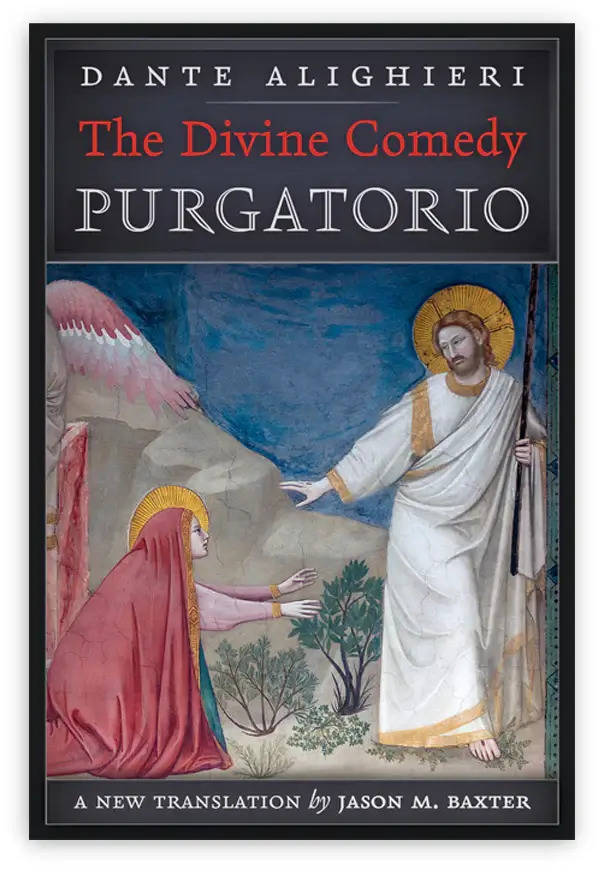
If you think classic literature is beyond your scope, this new translation by Jason Baxter will delight you. Written in modern English, it is easy to read and yet vibrant in its descriptions. The footnotes fill in the necessary background details without becoming too heavy or convoluted.
The historical context of Purgatorio is interesting in its own right. Dante was writing this book during a time when his country was being torn apart by wars between the Catholic Church, the Guelphs and Ghibellines. Don’t make the mistake of thinking that Dante was in favor of the Church’s political position. Many souls he meets along the way lament the poor choices of her leaders in navigating the wars, reflecting Dante’s own attitude. Dante himself was in exile at this time because of the political turmoil. As a post-pandemic read, it is very cathartic, and it is comforting to compare modern woes with Dante’s dire struggles.
Despite my childhood misgivings, this book would be enjoyable for anyone, Catholic, Protestant, Religious or Secular. If you are in the mood for a fantasy journey with beautiful imagery and a message of hope, you’re in the perfect mood to pick up this classic. If you haven’t read Inferno, that will not be a problem. Baxter’s footnotes will fill you in on the details you need to know to enjoy the story.