Genre
Non-fiction
Audience
Catholic, American
Author’s Worldview
Catholic
Year Published
2016
Themes
religion in the U.S. during the second half of the 20th century
Reviewed by
Courtney Guest Kim
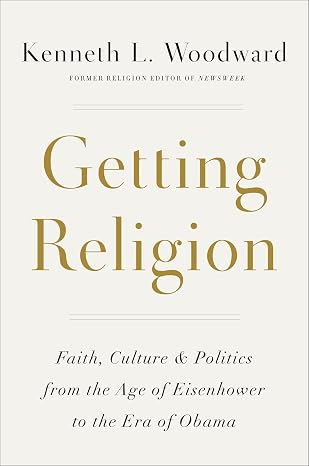
Ken Woodward, born in 1935, was the Religion Editor for Newsweek from 1964-2002. Getting Religion is his memoir: it blends his personal reflections as an American Catholic who came of age in the 1950s with his professional experiences interacting with all the major religious figures of the second half of the twentieth century. Most fascinating are the details of his personal relationships with key figures such as Billy Graham, the Dalai Lama and Rabbi Abraham Joshua Heschel, each of whom he became friends with.
His personal faith was formed in the pre-Vatican II era, and there is a nostalgic tone to his reminiscences, both as to the older forms of worship and as to American culture generally in the post-war golden age of the Fifties. When he was twenty-eight years old, this Midwestern Notre Dame grad showed up at Newsweek with some samples of his work from the Omaha Sun (as an afterthought, since he was in New York to apply for a job at Time). As he tells it, Newsweek in 1964 needed someone to cover Vatican II who actually knew about Catholicism, and they had no Catholic among their staff, most of whom were Ivy League grads. So, they took him on. He ended up staying for nearly forty years at the weekly news magazine, which by the turn of the millennium had reached a peak circulation of 3.14 million.
The bulk of Getting Religion is not so much a history of religious beliefs in the abstract as a description of America over the course of the second half of the twentieth century, with religion as the organizing principle of the narrative. Woodward describes trends in American Catholic subculture, such as the changes that occurred as birth control became the national norm, and the fissures that formed within traditionally Democratic Catholic communities after Roe v. Wade. He discusses the spread of secularism throughout the country as a sort of alternative religion, especially the therapy culture that overtook lifestyles hollowed out by atrophying religious observance. He talks about Jewish trends too; Women’s Lib and the phenomenon of gender issues; the 1960s counterculture and the influence of Hinduism. Cult figures such as Dr. Moon have a place in the discussion; as does Mormonism. Woodward traces the rise of Evangelicalism both in religion and in politics and gives a finely-tuned analysis of the morphing of the Republican Party into the Religious Right. The Democratic Party meanwhile aligned with liberal Protestantism, even as mainline Protestant denominations were in decline, a trend that Woodward attributes to the spread of liberal theology.
Woodward’s method of organizing all this material is an adroit balance of the chronological and the topical. He was, after all, editor of one of the two most influential weekly American news magazines, and there is never a dull moment in this complex sequence of intertwining narratives. The overall arc is from the “embedded religion” of post-World War II communities, through several decades of fragmentation and reshuffling, to a sort of coalescing of two major camps at the turn of the millennium. His vantage point is unique in that he writes as a practising Catholic who was employed by a secular news organization to cover all religious topics for a mainstream audience. He is candid about both the people he liked and those he disliked. There are many funny personal anecdotes, as well as caustic (and hilarious) observations about famous people. The book is worth reading just for these up-close-and-personal inside stories about the many public figures he interacted with.
But Getting Religion is not just an entertaining tell-all. Woodward has thought deeply about many crucial topics, and he lays out his conclusions from a frankly Catholic vantage point. The result is a must-read for anyone who wants to understand what happened in American culture over the second half of the twentieth century. Any American who is new to Catholicism will find answers in this book to lots of perplexing questions. The best thing about this book is that when you’ve finished it, you feel that at last someone has explained the relationships between trends and events that are usually discussed as separate from each other. You get a feeling not only of what happened but why, at a much deeper level than the usual historical and sociological analysis. If you’ve ever felt that there are missing pieces in explanations of the religio-cultural landscape today, as compared to the near-mythical time when most people in the U.S. were some sort of Christian, Woodward has those pieces.
Woodward retired a few months after the Boston Globe broke its Spotlight series on clergy sex abuse in January 2002. So, his book does not cover that topic, nor the rise of Islam as a ubiquitous preoccupation post 9-11. However, his comprehensive, multi-faceted descriptions of the various forces and trends in American culture help to give context to those events. Getting Religion is a pithy, mordant and compelling memoir: suitable for anyone who is looking for an entertaining, readable and formidably well-researched discussion of American society as understood through the lens of a devoutly Catholic worldview.