Genre
Audience
Author’s Worldview
Catholic
Year Published
2024
Themes
Vocation, Irresistible Woman, Historical, Romance, Anglo-Saxon, Cuthbert Series, Christendom, Moors, Vikings, Way of Saint James, Camino, Charlemagne
Reviewed by
Theresa Frodin
When a man meets his irresistible woman, does his virtue improve if she loves him in return? Is she the power that gets him to slay the dragon? What if she is an agent of chaos and leaves him brokenhearted? What then? It’s a tale and a question as old as time: who is Adam without Eve, Paris without Helen, Dante without Beatrice, the Beast without Beauty, and Theodemir without Agnes?
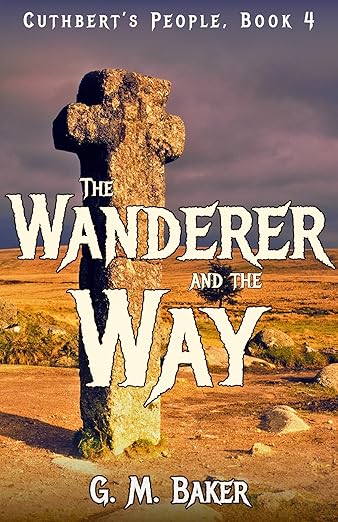
The Wanderer and the Way is the fourth book in G.M. Baker’s Cuthbert’s People series that continues to explore the life of the beauty, Agnes—formerly Elswyth of Twyford, after she and her companions have been taken by the Vikings. Catholic history fans of Anglo-Saxon 8th century may appreciate the author’s creative interpretation of the origin story of Bishop Theodemir who established the Camino de Santiago de Compostela in the midst of the struggle between Christians and Moors. Historical fans may also particularly appreciate Baker’s inclusion and references to the famous Frankish king and key founder of Christendom, Charlemagne.
The book begins before Theodemir of Iria Flavia becomes bishop, when he is a young man and is returning to his uncle’s villa after a disappointing pilgrimage where he didn’t find spiritual fulfillment. In Rome, he had momentarily fallen into fornication, and was grappling with confusion in his vocation. Now in Iria Flavia, the current bishop believes that Theodemir can be of use in finding Saint James’ grave—a task that Theodemir is not enthusiastic about. Theodemir is also called to leave Iria Flavia to serve as ambassador to Alphonso, the Visigothic king of Asturias—another calling that he resists. His vocation is further called into question when he meets Agnes, his uncle’s gatekeeper. She is a riddle in the flesh: everything about her mystifies him. Eventually, he kidnaps her on his way to serve the king in order to save her from being raped by his evil uncle. Now, with this irresistible woman traveling with him, can he win her heart? Or will he bring her to more peril?
Agnes’ heart is in so much turmoil that she finds herself deadened and cynical towards all men. Will Theodemir be the key that unlocks her heart? Can Agnes forgive herself and her past? Can she fall in love again?
Once again, Baker did not simply entertain, but allowed for me, his reader, to discover philosophical undercurrents in this story. He did not dictate what must be discovered, but allowed deeper thought by simply adhering to the art of storytelling—a commitment he has for all of his novels: “[b]ecause only a true thing, a true experience, can produce reflections of any merit or interest.” As I read this historical romance, I was drawn to contemplate the meaning and experience of “vocation” through the two main characters. In an active way, Theodemir claimed purpose for himself by weighing the disappointments and enthusiasms in his life, the pressure from society and the church, and his own desire to act. Secondly, I saw vocation in a more passive way through Agnes’ brokenness – when passion and ambition seem to cause nothing but pain. In her desire to avoid hurting anyone else, she suppressed parts of her earlier wistful personality, and no longer tries to find or be anything other than what she currently is. Was this an abandonment of her true self, her true calling? Or was this “acceptance” a new, better vocation?
Baker believes “a novel should be a good story as a ship should be a good ship, and as a meal should be a good meal, a real thing whose truth is to its nature, form, and purpose.” In his pursuit of the real, Baker does not sugarcoat history or human nature. He depicts ugliness and allows discomfort. This quality, though, may not be appealing to all of his readers; some might even find certain scenes or topics sensitive or inappropriate. In The Wander and the Way, there is a rape scene (and others that are alluded to); however, Baker keeps this scene clean and short. Still, some readers may be disturbed by the malicious intention of the rape. The rape occurs, not because of passions gone awry, but because the uncle uses it coldly and casually as a power play, not over the poor girl, but in order to threaten Theodemir, who is rightfully disturbed. While the rape happens within the culture of the time as well as in the development of Theodemir’s journey from lust and fornication to chastity – a remarkable task considering that rape is common in his own household, reader discretion is advised.
For those interested in Baker’s understanding about the art of storytelling, readers may visit his Substack