Genre
Audience
Author’s Worldview
Year Published
Themes
Reviewed by
When I was asked to review Richard Spinello’s Four Catholic Philosophers: Rejoicing in the Truth, my first thought was that the task should go to someone with more than my passing interest in or knowledge of philosophy. But in the end, I am glad the task fell to me.
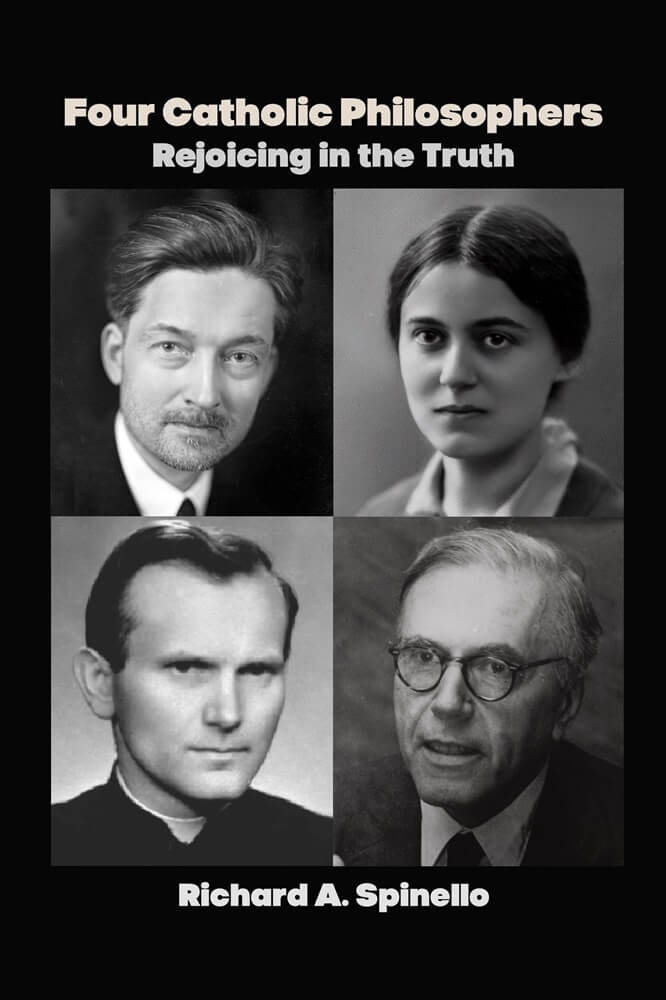
From the title, I was expecting that this would be a book about the philosophical thought of its four subjects, Jacques Maritain, Edith Stein, Dietrich von Hildebrand, and Karol Wojtyła, the future Pope John Paul II. But while that is certainly part of what it is about, it really consists of four brief biographies of these modern Catholic philosophers. The book discusses their ideas in the context of their lives, which were all touched in one way or another by the destructive ideologies of Nazism and Communism in the twentieth century.
By setting the philosophical issues within the context of the lives and times of his four subjects, Spinello goes a long way towards explaining why Maritain, Stein, von Hildebrand, and Wojtyła cared so deeply about the questions they were attempting to address. More than answering the questions themselves, this book may serve principally to show why people might care about these questions, why the questions matter, and why four notable Catholics lived and died for the importance of their answers. As Spinello says,
“But arguably the most important legacy of these four Catholic philosophers is their admirable life stories. They are models of courage and heroic virtue for Catholics and others who must now navigate the hazardous terrain of the modern culture wars.”
It is impossible that a brief book of this kind could give the reader a complete and clear account of all the questions it addresses. But the discussions of philosophical topics do serve to give a sense of the nature of the philosophical mind and the way in which the possession of such a mind can affect how a person lives. And one cannot help thinking what a trial it would be to be born with a mind that cannot ever be content until it has puzzled out these questions to the final degree. As Spinello quotes Stein saying, “Unless one clarifies all the principles involved, it is impossible to arrive at a clear solution.” But, of course, most ordinary people will settle for a solution that mostly works and move on to the next problem. Sometimes we need philosophers to show us the flaws in our hasty solutions.
The great virtue of this book, I believe, is not that it gives you an insight into the great philosophical questions, though it may do that to an extent, but that it gives you an insight into the lives of those blessed or cursed with great philosophical minds. However abstract and obsessive the philosophical mind may be, it seems to prepare people for remarkable stoic courage when it is called for. This was, for me, the most fascinating aspect of the book.
Writing a popular book on philosophy is difficult. Not only is the language of philosophy complex and abstruse, it cannot easily be translated into simpler terms, because its language is designed to capture and express distinctions that most of us never think about in our ordinary lives. We have no words for these distinctions because we never make them. Overall, the book is written as clearly as I think it reasonably could be, given the subject matter. However, the reading level does vary over the course of the book. At times, it is deeply and technically philosophical, and at other times somewhat simplistic in its narration of events.
The book also varies in tone. For the most part, it gives an objective biographical account of its subjects, but in places it takes on a hagiographic note, with passages in which the author claims to be able to see the operation of grace in his subjects. Many readers will welcome these passages, I am sure, but I would have preferred a more dispassionate tone that would have given me greater confidence in the objectivity and balance of the work.
Despite these variations in tone and style, however, Four Catholic Philosophers: Rejoicing in the Truth is as lucid and easy to read as its subject matter allows, and it succeeds in imbuing the lives of its subjects, and even the progress of their thought, with a sense of drama.
While the book presumes the correctness of the Catholic Faith and its body of doctrine, and presents it as fundamental to the philosophical thought of its subjects, non-Catholics with an interest in a philosophical response to the prevailing philosophies of the modern world will probably find it helpful. Readers of all faiths and none should be able to find in it four profiles in courage and a fascinating examination of how the rigors of philosophical thought can stiffen the spine and inspire courage, courage even unto death.