Genre
Audience
Author’s Worldview
Catholic
Year Published
2024
Themes
Mass, spirituality, prayers, Latin Mass
Reviewed by
Marcia Friel
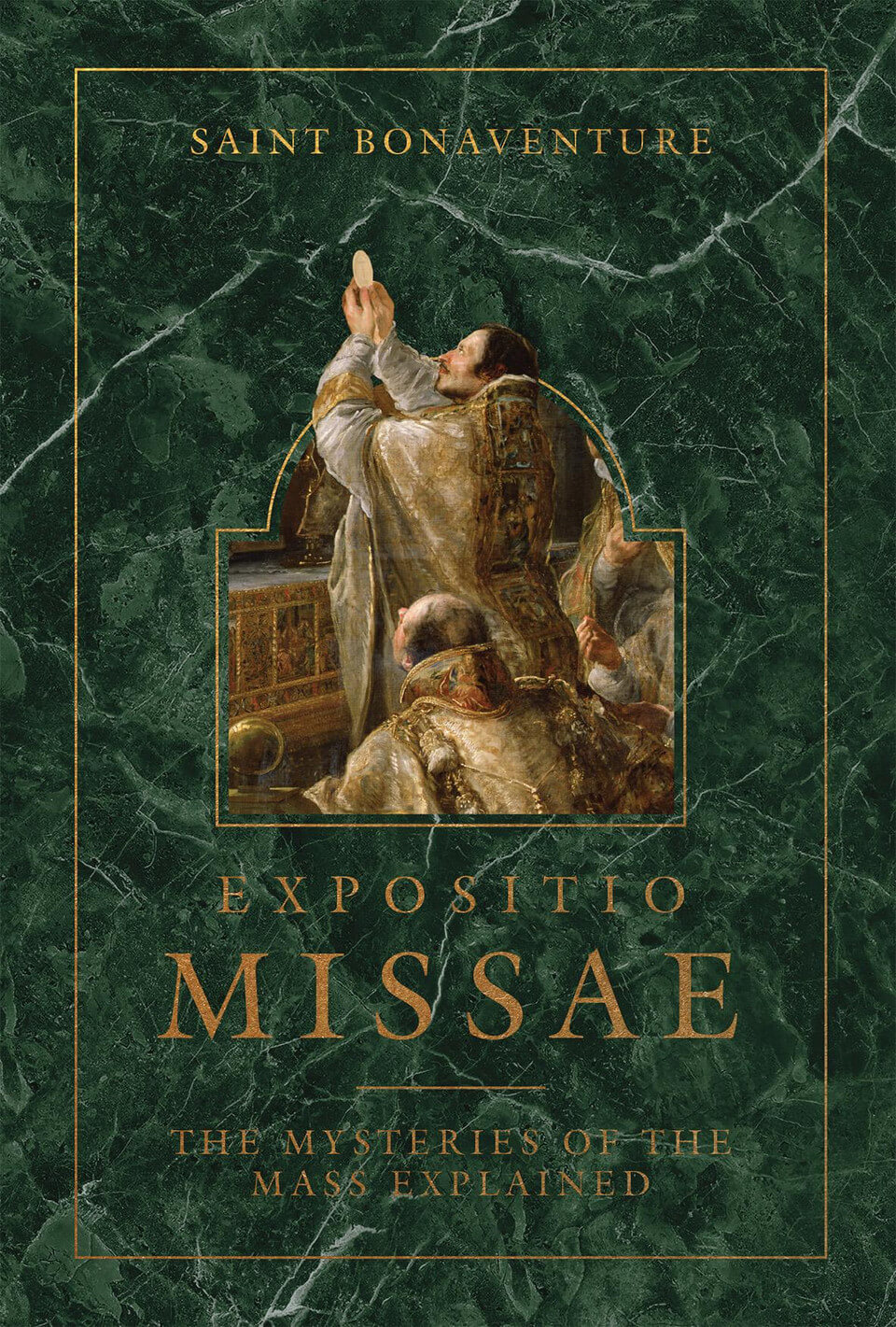
Expositio Missae (Exposition of the Mass): The Mysteries of the Mass Explained is a new translation by Fr. Robert Nixon, published by TAN Books, of an original work by St. Bonaventure. Saint Bonaventure, Doctor of the Church, is considered one of the great thinkers of the 13th century and is heralded for both the breadth and depth of his writings. His commentary on the Mass is a well-detailed description of the symbolic and spiritual tradition of the Eucharistic celebration.
This translation includes two of St. Bonaventure’s original prayers—a prayer for before Mass and a prayer for after Mass. Because the Mass has changed in certain ways over the centuries, the text and accounts most closely correspond to the Tridentine Mass or Traditional Latin Mass.
This book is not an explanation of when to sit, stand, or kneel. Rather, it is an in-depth exploration of the symbolism within the Mass, including the placement of items on the altar, every gesture by the priest, and each word uttered by the officiant and congregation during the Eucharistic assembly. Because of the rich history and extensive symbolic representation inherent in the Holy Mass, there are many things that even weekly Mass attendees like myself, pass over without contemplating. This book reminds us of the deep liturgical history of the Mass.
New converts may also be interested in this book in order to further learn about every aspect of the Mass and why it has been virtually unaltered for thousands of years. Details may have been adjusted for a few practices, but Exposition of the Mass shows that much of the Mass has remained unchanged. Some knowledge of basic doctrine and practices is necessary to fully understand the meanings and symbolism St. Bonaventure expounds, largely due to his use of Catholic vocabulary and references to items and practices during the Mass. Therefore, those who are looking for a basic tutorial will not find what they are looking for here. Because the book was originally written in the Middle Ages, the descriptions most aptly apply to the Latin Mass; however, much of the symbolism and practices also apply to the Novus Ordo (as referred in the footnotes) or Ordinary Form of the Mass, allowing the text to show similarities in both rituals with the footnotes also noting some of the disparities.
I cannot compare this translation with others, nor comment on its accuracy to the original Latin writings. In his footnotes, Fr. Nixon explains his deviations from earlier translations, which attempt to further clarify St. Bonaventure’s points. He also makes note of possible errors and confusions in St. Bonaventure’s original texts such as a reference to St. Anastasia as a virgin-martyr even though she is believed to have been married. Fr. Nixon is also careful to note certain historical details such as the fact that during St. Bonaventure’s time the non-baptized were not permitted to be present during the Consecration. These footnotes are helpful and brief so as not to bog down the overall spiritually instructive tone of the work. Moreover, he connects what is said in the Mass to Scripture with clear and concise Biblical references in the footnotes.
Throughout his examination of the Mass, St. Bonaventure offers erudite illuminations to teach and guide. He informs readers about symbols like that of the altar that is “covered with a clean, white cloth, just as the cross itself was adorned by the pure and spotless humanity of Christ.” He also offers prescriptive suggestions claiming, “The Canon itself should be spoken in a well-judged manner, and in an undertone.” Despite being relatively short in length, just over 100 pages, the elucidations are rich, uncovering many layers of the Divine Liturgy, making the lessons dense with details.
This translation is both scholarly and organized in its presentation. I might be coming back to this book for reference, as one read-through is not enough to fully appreciate the depths uncovered. By reading this book, may you achieve one of St. Bonaventure’s goals, “to hear the most holy Mass with the greatest possible devotion and reverence.”