Genre
Audience
Author’s Worldview
Catholic
Year Published
2019
Themes
Reviewed by
Tiffany Buck
Have you ever wondered where the ladybug got its name? In The Legend of the Ladybug, author Maria Illich takes readers to the age of miracles, in France. The story takes place in a small village in Burgundy, where a plague of insects, a little girl mourning the loss of her mother, and the Blessed Virgin Mary intersect in this beautiful retelling of the ladybug legend.
Lonely Brigitte is heartbroken over her mother, Lady Genieve’s death. She has no siblings, and her father has forbidden her to play with the peasant children. Her only companion is Nettie, the woman who helped raise her. The peasants under Brigitte’s father, Sir Marcel La Fleur mourn the loss of their kind lady who brought bread to the poor. Sadly, the loss of his wife left a hole in the heart of Sir Marcel. Those under his care suffer from his lack of interest in their wellbeing.
Brigitte’s mother taught her the importance of sharing with those in need. Every morning Lady Genevieve and Brigitte used to pray in front of the statue of Mary and attended Mass, before passing out bread to the poor. After Lady Genieve’s death, Brigitte continues to do her mother’s good work. Tragically, a terrible plague of insects falls on the village, destroying most of the crops. While peasants starve, Brigitte prays fervently for the intercession of the Blessed Virgin Mary to remove the destructive insects. As all Catholics know, God never leaves our prayers unanswered.
Applying a fresh take on an old legend, Illich skillfully describes the virtue of charity. A simple act with a pure heart done in charity brings peace and joy, as well as unity. The peasants see their Lady Genevieve in Brigitte as she does her best to take care of them. Sir Marcel puts his grief aside, realizing that the kindness of his wife has passed down to their daughter.
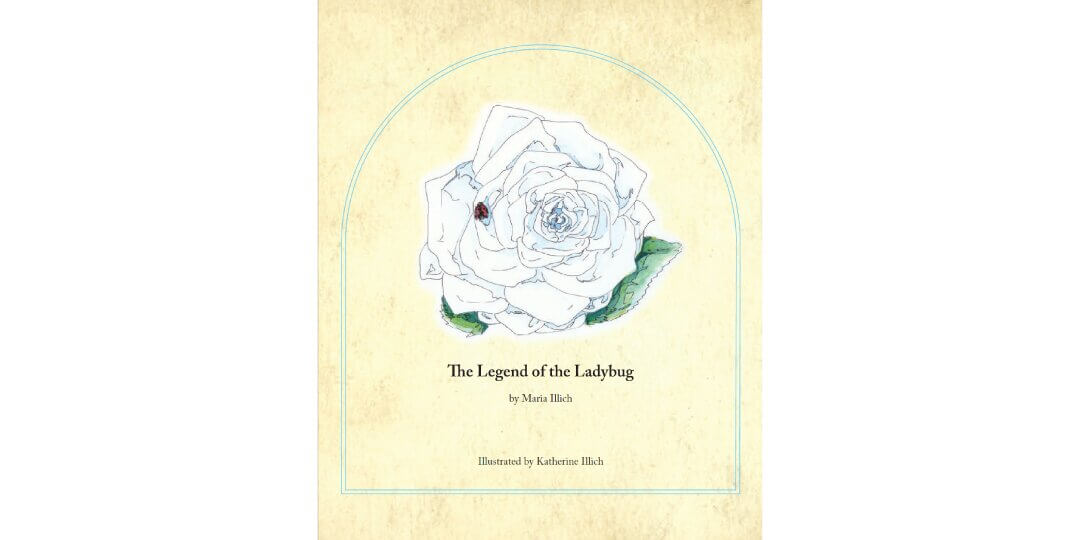
Author Maria Illich teams up with her illustrator daughter, Katherine Illich to create a beautiful reimagining of an old medieval European legend. Each page contains a picture on one side and a part of the story on the other. The drawings are beautiful and look as if they were done with watercolors. The pages have a tea stain color to them, adding a somewhat older feel to the book. For the more curious readers, Illich adds more information on the ladybug at the end of the story. There is a page on ladybug logistics as well as a bit more information on the ladybug lore, including the significance of the black dots on the ladybug and a bibliography. Lastly, Illich adds a ladybug lingo page where you can learn to say ladybug in forty different languages.
The Legend of the Ladybug is an enjoyable read from cover to cover. As a homeschool mom, I am impressed with all the lessons students can learn from it. From a single book, a young student can be taught history, catechism, literature, science, and language arts. Indeed, it is a treasure trove for the Catholic homeschool library of families with small children.